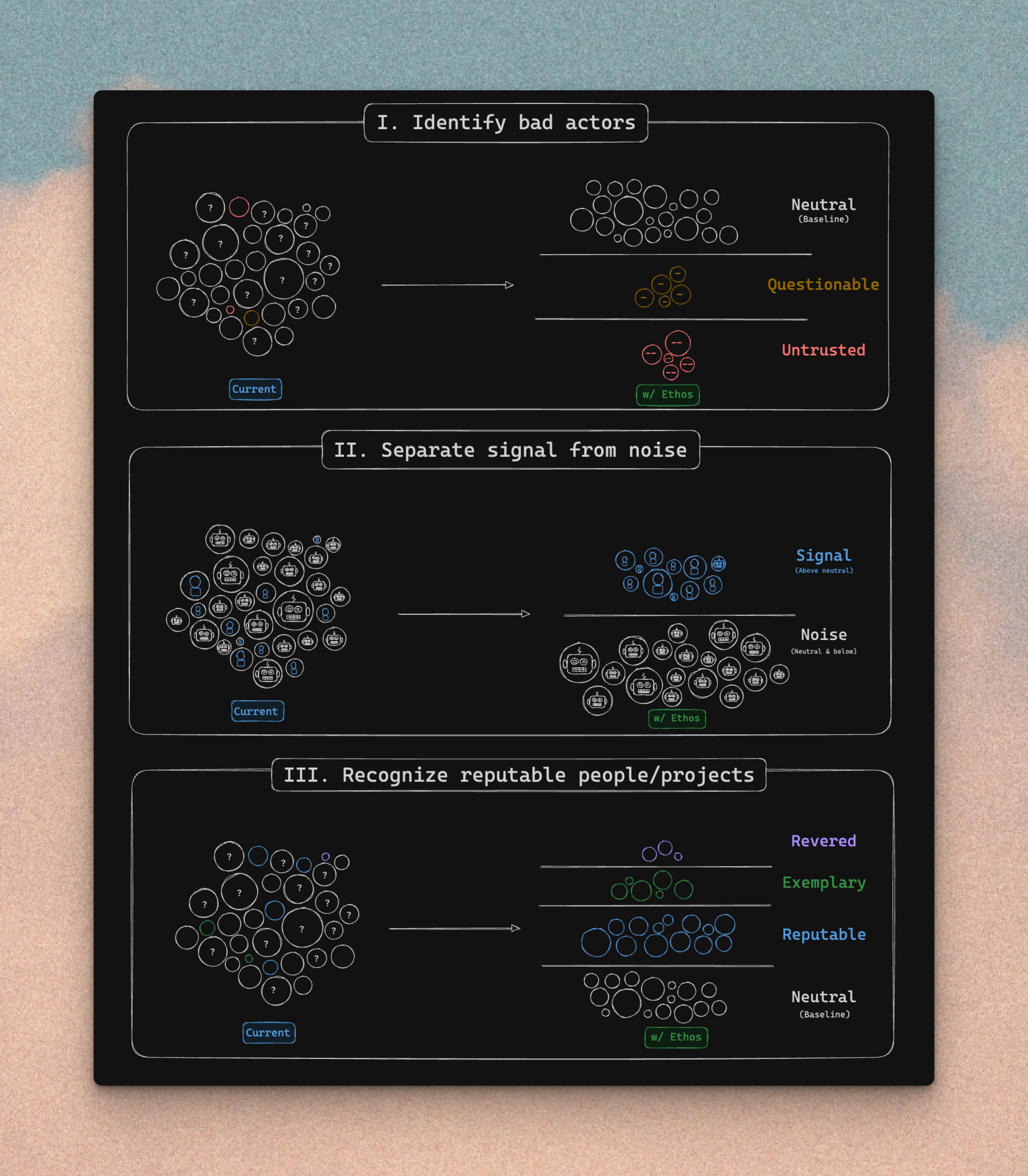
The Ethos score is intended to solve three problems:
- Identify bad actors
- Separate signal from noise
- Accurately recognize reputable people & projects
113 days in, how are we doing on each of these? Here's our honest assessment.
Problem I: Identify Bad Actors
STATUS: Healthy | CONFIDENCE: Medium
The problem statement Ethos has been focused on thus far is the $9B+ lost every year to various types of scam, fraud, and deception. Identifying "bad actors" and democratizing that information has been one of the most important parts of the Ethos score.
As new market participants join web3, it's important for them to understand who's untrustworthy or questionable, based on market consensus. With the Chrome extension, we're now helping people avoid overtly bad actors.
Problem II: Separate Signal from Noise
STATUS: Healthy | CONFIDENCE: Medium
Another issue we have in web3 is identifying "authentic" users from "fake" ones. Participants and projects have leveraged cheap, spoofable credibility to create legitimacy. Now with AI, this is easier than ever. Inauthentic "signal" is easy and cheap to spoof.
With Ethos' 115k reviews, this is starting to work. Having a single review against a name can go a long way at adding signal to profiles. This has allowed us to ship "hide low credibility posts" on the Chrome extension.
Problem III: Recognize Reputable People & Projects
STATUS: Needs Work | CONFIDENCE: Low
The hardest part of the equation of reputation is accurately representing the nuance of relative reputation. How do you confidently say Person A is more reputable than Person B?
This is a separate problem than the others as we are highly dependent here on true positive social signals from Ethos. It also represents where we are most prone to reputation spoofing, even though it requires others to review/vouch for you.
The Core Thesis
While it's trivial to buy X followers, likes and views on posts, etc., it is still difficult to spoof reputation on Ethos—you need someone else to vouch for you.
This has always been the core thesis of Ethos: Make reputation expensive in social or financial capital to spoof.
Room for Improvement
While we do believe we provide more defense against this today than just buying followers, there's still a lot of room to improve.
As an example, most people would not agree that @0x5f.eth is more reputable than @VitalikButerin, but his score is much higher. False positive.
So by way of "recognizing truly reputable people and projects," we think we have a lot of work to do before the data is refined. This will happen with time as the protocol and data matures.
How We're Addressing This
Through our EIP process, we've started to make adjustments with the intent of addressing problem 3 head-on.
Pre-EIP changes, EIP-1 & EIP-2 were all directly aimed at solving the problem of accurately recognizing reputation (while combating spam) much better.
The Bottom Line
All said, after 113 days of being live on Base, we've grown more and more confident in our ability to:
- Ensure info about known bad actors is democratized
- Start to separate signal from noise
- Reliable reputation data on those who are truly reputable (still in progress)
This is significantly further than we imagined being just 113 days in.
We'd love your feedback:
- How would you rate us on these three points?
- How would you stack rank each problem's importance?