We've recently invested heavily in understanding more about our Ethos users and how partner teams can leverage this data in everything from GTM to token sales. This article is based on research done internally, which can all be found on the research microsite
Imagine for a second you're a marketing agency, and you're tasked with launching a new luxury car that costs over $200k
You've got $5m to spend on the marketing, do you... A. Print paper fliers, employ 500 people for 30 days and hand them out physically at every McDonald's in Manhattan B. Create, film and advertise commercials that air on Nickelodeon at 11am EST C. Create a curated, exclusive wine gathering in a penthouse where you invite media, wealthy hedge fund managers, and NYC's elite to unveil your latest car
The McDonalds crowd is not buying a Rolls Royce, sorry. In web3, we've somehow forgotten this lesson.... and it results in teams spending large amounts of money on advertising to the wrong users.
Most crypto marketing campaigns today are still spray and pray.
→ A token sale gets blasted to "all of crypto Twitter" with a nice InfoFi campaign. → A new app pays for top-of-funnel reach with no filter on whether the people seeing it have ever held more than $5 in their account. → A KOL deal goes to the biggest follower count, regardless of whether that audience has onchain capital (or reputation.)
The result is what every founder and growth marketer in this space already feels: CAC keeps climbing, conversion rates stay flat, and the dollars you spend reaching "everyone" mostly land on wallets that physically cannot convert. Spending money on a marketing agency that can drive hype on X does not convert into activation of new users.
So we ask:
What if you could see, before you spent a dollar, which crypto users actually have purchasing power? Which users will actually convert into LTV?
II. What the data says
We pulled holdings data on every Ethos profile - 36,746 of them - and cross-referenced each one against onchain assets held by those users. Every Ethos score is tied to a real X account and a real wallet, so this isn't a sample of anonymous addresses. It's a one-to-one mapping of credibility to capital.
Keep in mind, the scores are driven ENTIRELY by social cues on Ethos, delivered by other people... not access to capital itself.
Let's look at the breakdown-
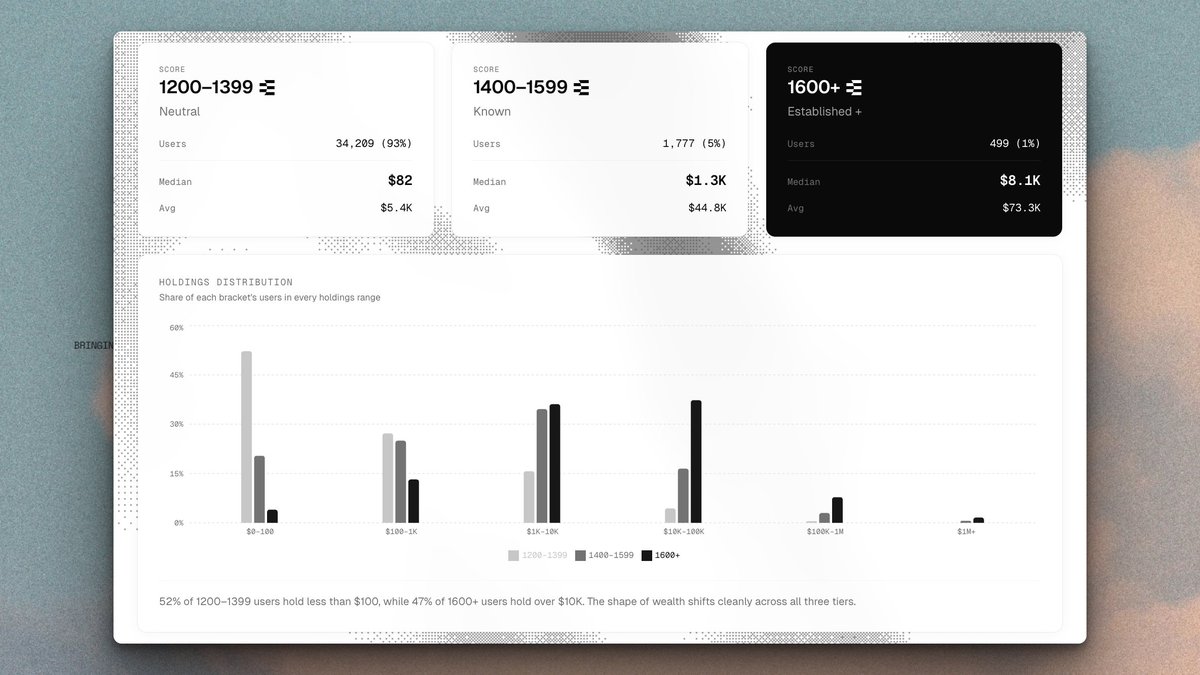
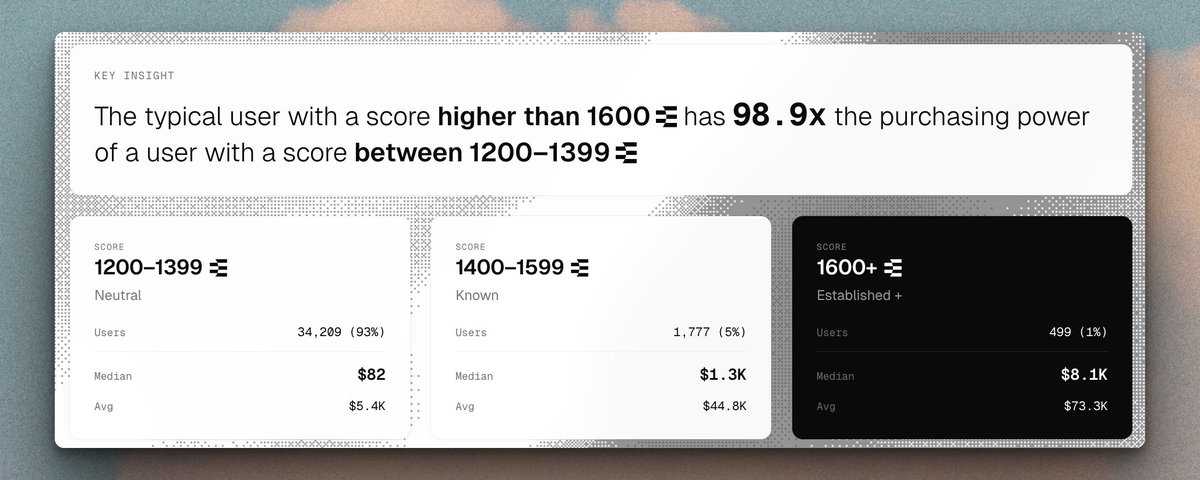
The Neutral tier (1200-1399) is where most of crypto Twitter lives. 34,209 users. 93% of the scored population. Combined holdings of $52.0M, which sounds like a lot until you divide it out - that's roughly $1,520 per user. Only 21% hold over $1k, just 5% hold over $10k... More than half hold less than $100.
This is the audience most web3 campaigns are paying to reach.
The Known tier (1400-1599) starts to shift. 1,777 users, $20.3M combined, 55% hold over $1K, 20% over $10K
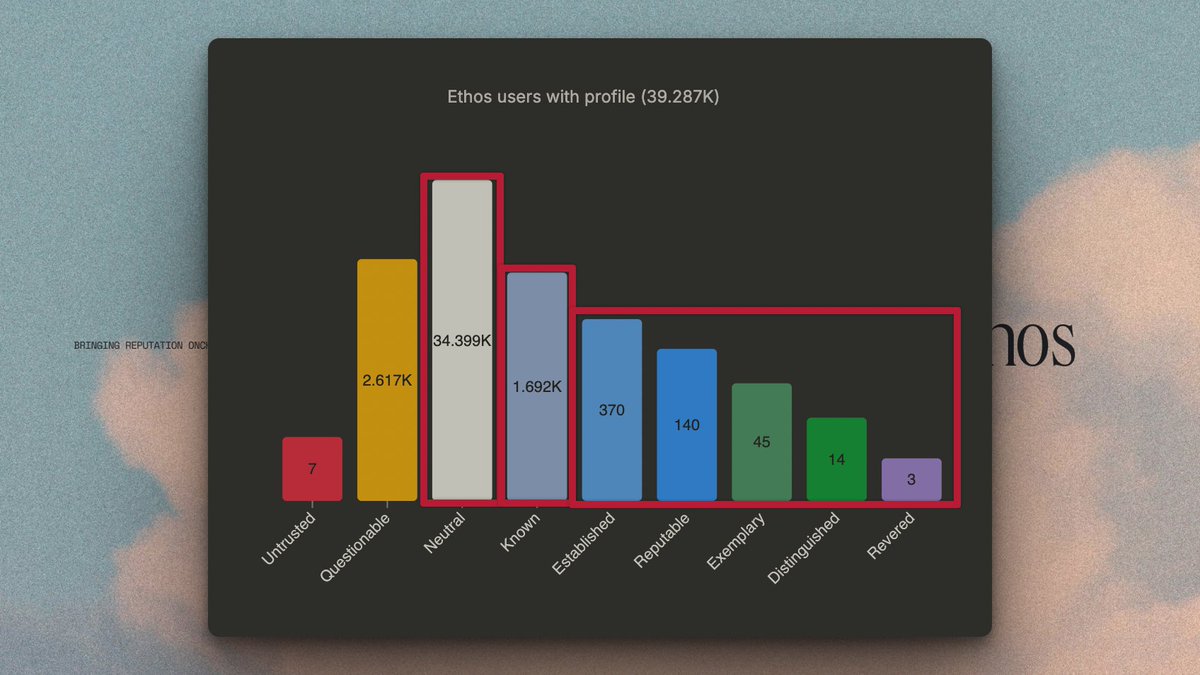
Then there's 1600+. Just 499 users - 1% of the scored population. But:
- $36.6M in combined holdings
- 83% hold over $1K
- 47% hold over $10K (233 wallets)
- 96% hold over $100
- 78.6% actively deploy capital in DeFi
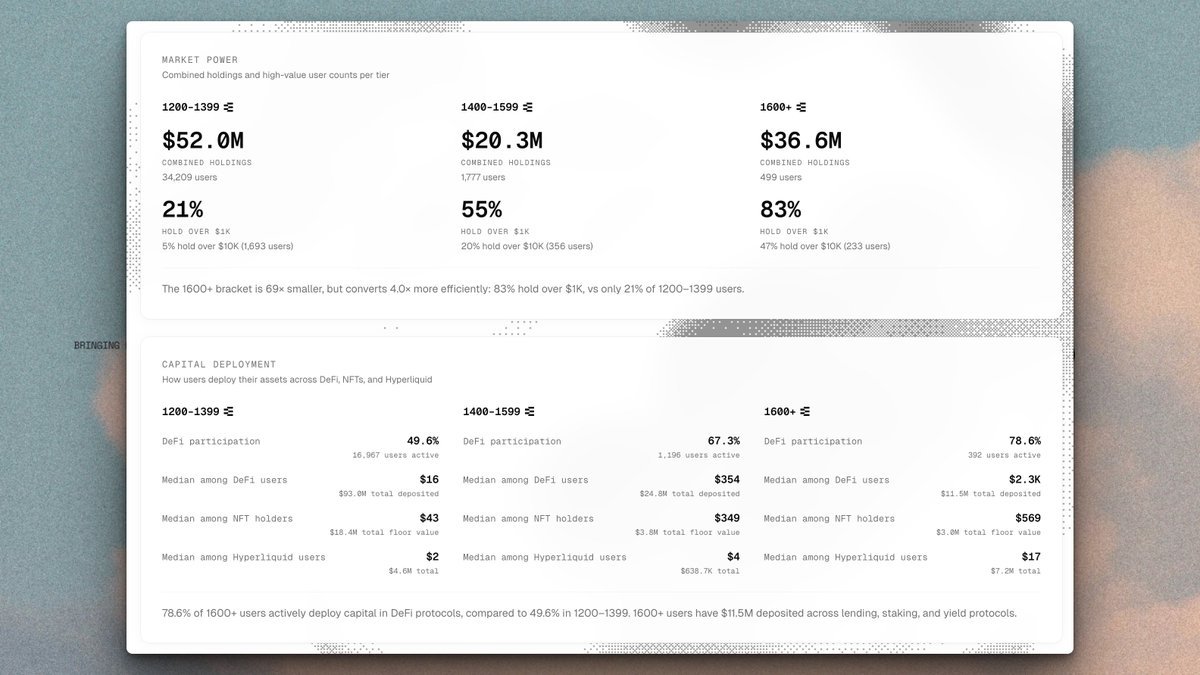
The 1600+ tier is 69x smaller than the Neutral tier. And 98.9x more valuable on a per-user purchasing power basis. That's not a marketing line - it's what falls out of the data when you compare a typical reputable user against a typical Neutral user.
The shape of the wealth distribution doesn't just shift across tiers... it inverts. Neutral users cluster at $0-100. 1600+ users cluster at $10K-$100K.
III. Why this matters for your CAC
If your CAC math assumes a flat audience, you're overpaying. Every dollar you spend reaching the bottom of the distribution is a dollar that statistically can't convert into a $1K+ position, a presale allocation, an LP deposit, or whatever your real success metric is.
When you filter on credibility instead, three things happen at the same time.
- CAC drops because the denominator gets honest. You stop counting impressions on wallets that were never going to convert. The 233 wallets in the 1600+ tier that hold over $10K aren't a statistical fiction - they're a directly reachable list, because every Ethos score is tied to a real X account.
- 2. Conversion rates rise because you're reaching people with capital. On the "holds over $1K" filter alone, the lift is 4x. The deeper you filter, the steeper that curve gets.
- 3. Sybil resistance gets built in. Ethos scores require real social and on-chain history to climb. Bots can't fake their way to 1600+. This is the same property MegaETH leaned on when they filtered 53,000 token sale participants down to 6,000 - taking $1.39B in commitments while keeping the wallets that were going to dump on day one out of the room.
IV. The proof
The cleanest case study we have on this is Cambria's token presale.
Cambria didn't gate their presale on Ethos scores. They just let everyone participate and observed what happened. Of 960 participants, 568 had Ethos scores. Those wallets committed 66% more capital on average.
Same campaign, same product, same window. The only variable was whether the wallet had earned onchain reputation.
That's the size of the lift sitting on the table when you stop treating all wallets as equal.
And this isn't a one-off. The same pattern shows up everywhere in the secondary data. Median NFT holdings move from $43 (Neutral) to $349 (Known) to $569 (1600+). Median Hyperliquid balances move from $2 to $4 to $17. DeFi participation moves from 49.6% of Neutral users to 78.6% of 1600+ users. Every dimension of "has real on-chain activity" moves in the same direction with credibility.
V. What to do with this
If you're running a token launch, a product launch, or a paid creator program, the question isn't "how do I reach more crypto users?"
It's "how do I reach the crypto users who can actually pay?"
A few concrete moves:
Filter your target list before you spend. Whether you're running ads, sending allowlist invites, or paying KOLs, score the audience first. The 1600+ slice is small but reachable.
Reweight your KOL deals. Thousands of influencers took undisclosed payments in 2025, and most of their followers don't have capital anyway. A smaller creator whose audience overlaps with 1600+ Ethos users will outperform a mega-account whose audience is 90% Neutral.
Gate the high-leverage moments. Presales, OG allocations, beta access - these are exactly where credibility filtering pays for itself. Cambria's +66% lift is what that looks like in dollar terms.
Stop optimizing for vanity reach. Wallet count, follower count, and impression count all flatten across the distribution. The wallets you actually want are concentrated. Treat them that way.
VI. The takeaway
Web3 acquisition has been broken in the same way for years. Teams pay to reach everyone, then act surprised when conversion rates look like consumer ad rates on a market 1/100th the size. The fix isn't bigger budgets. It's a better filter.
In the early days of web2 the internet had the same problem - do you spam advertisements for a new cookware set on the Toyota Supra bulletin board? That market evolved in the same way as Ethos is evolving web3 - you simply know more about your target user (and thus why instagram ads for boutique sales does so well)
Ethos credibility scores are that filter - not because we say so, but because the onchain data shows a clean, monotonic relationship between score and purchasing power across 36,746 profiles. A 98.9x per-user purchasing power gap is not a rounding error. It's the size of the inefficiency hiding in every spray-and-pray web3 campaign on the market.
The reputable tier is small, real, and directly reachable.
If you're launching something, that's where your dollars should go.
Oh and we give all of this away for FREE.. go check out our developer docs at https://developers.ethos.network to see how you can integrate your scores and know more about your users. Or, reach out to us via the form listed on https://app.ethos.network/exclusive-access Referenced reports: - https://score-vs-holdings.ethos.deno.net/ - https://app.ethos.network/data
This article first appeared on X.